91°F
Sunny
Data: NOAA/National Weather Service. Forecast updated Oct 17, 2026, 11:56 PM UTC. Discussion issued Oct 17, 2026, 9:03 PM UTC.
Air Quality Index: 54 (Moderate)
No rain expected in the next 2 hours.
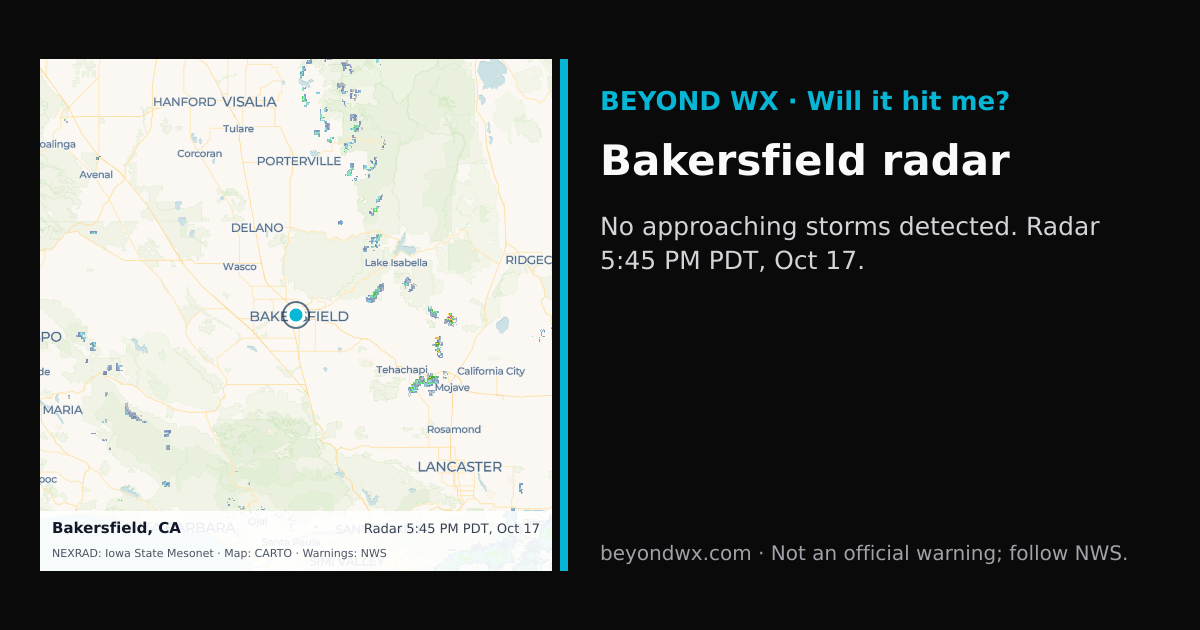
No storms on track toward Bakersfield right now.
Hourly NWS forecast and radar storm motion. Times are local. Not an official warning; follow NWS.
Share: storm card image · live radar
Bakersfield, CA, located at 35.3733°N, -119.0187°W, experiences a semi-arid climate characterized by hot, dry summers and mild, wetter winters. This climate classification results in a landscape that is more arid than areas further north but less extreme than desert conditions. The region's climate is influenced by its geographic position in the southern portion of California's Central Valley.
In the summer, Bakersfield sees average high temperatures reaching into the upper 90s Fahrenheit, with occasional peaks over 100°F, while nighttime lows typically fall to the mid-60s. Winter temperatures are much milder, with daytime highs generally in the mid-50s to low 60s, and lows in the upper 30s to low 40s. Spring and fall offer transitional conditions with moderate temperatures, making these seasons relatively pleasant.
The city receives an annual average rainfall of about 6-7 inches, with most of the precipitation occurring between November and March. December through February are usually the wettest months, while the late spring and summer months from May to September are notably dry. Snowfall is extremely rare, given the mild winter temperatures.
Bakersfield is susceptible to extreme heat events during the summer months, which can lead to increased wildfire risk in the surrounding areas. The region's low elevation in the Central Valley often contributes to air quality challenges, exacerbated by temperature inversions that trap pollutants. The nearby Sierra Nevada mountains do not significantly affect precipitation in this area, but they do influence local weather patterns, especially in terms of wind and temperature variations.