69°F
Clear
Data: NOAA/National Weather Service. Forecast updated Oct 16, 2026, 7:15 AM UTC. Discussion issued Oct 15, 2026, 11:47 PM UTC.
Air Quality Index: 51 (Moderate)
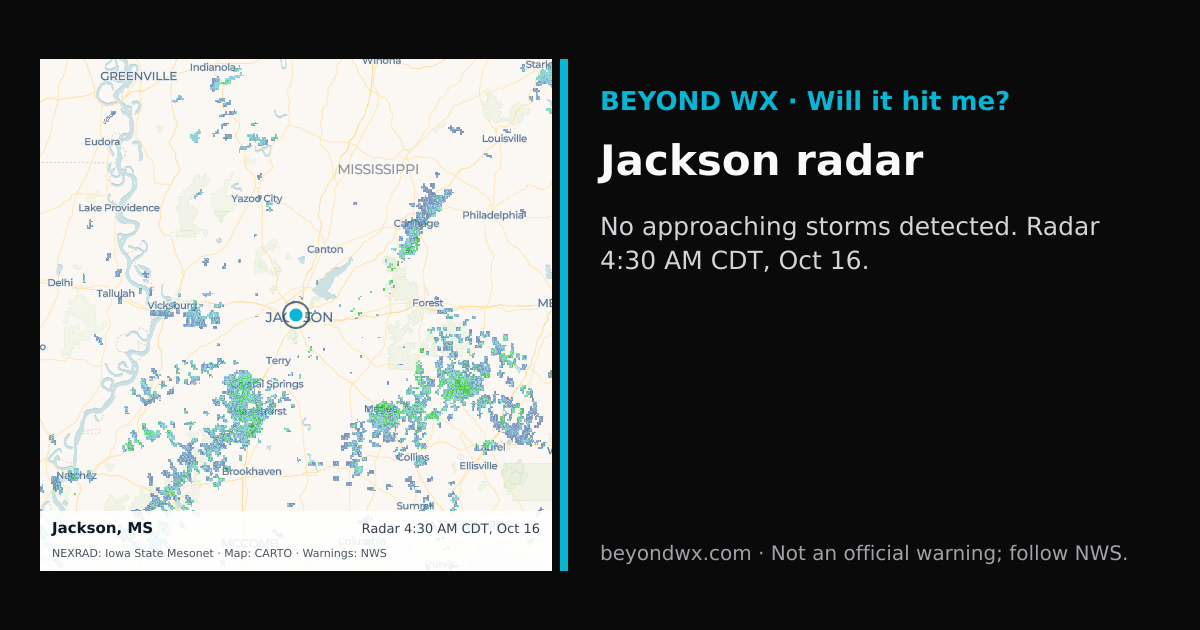
No rain expected in the next 2 hours.
No storms on track toward Jackson right now.
Hourly NWS forecast and radar storm motion. Times are local. Not an official warning; follow NWS.
Share: storm card image · live radar
Jackson, MS, is classified under the humid subtropical climate category, characterized by hot, humid summers and mild winters. This climate is typical for the southeastern United States, where moisture from the Gulf of Mexico heavily influences weather patterns. The area experiences a mix of seasonal temperature variations, with summer highs averaging in the low 90s Fahrenheit and lows in the low 70s. In winter, temperatures range from highs in the mid-50s to lows in the mid-30s. Spring and fall are transitional seasons with milder temperatures and are generally more comfortable.
Jackson receives an annual average rainfall of about 54 inches, with precipitation fairly well-distributed throughout the year. March typically sees the most rainfall, while October tends to be the driest month. Snowfall is rare, but occasional light snowfall can occur during winter months, contributing minimally to the annual precipitation total.
The area is susceptible to notable weather phenomena, including the risk of severe thunderstorms and tornadoes, particularly during spring. Jackson is also occasionally affected by the remnants of tropical storms and hurricanes from the Gulf of Mexico, which can bring heavy rain and strong winds. Extreme heat can occur during the peak of summer, with heat indices sometimes surpassing 100°F.
Jackson is situated in a relatively flat region with an elevation of about 300 feet above sea level, which means there are no significant geographic features to impede weather systems. The proximity to the Gulf of Mexico plays a crucial role in the area's climate, providing ample moisture that contributes to the high humidity and precipitation levels.