75°F
Clear
Data: NOAA/National Weather Service. Forecast updated Oct 16, 2026, 6:26 AM UTC. Discussion issued Oct 16, 2026, 5:56 AM UTC.
Air Quality Index: 53 (Moderate)
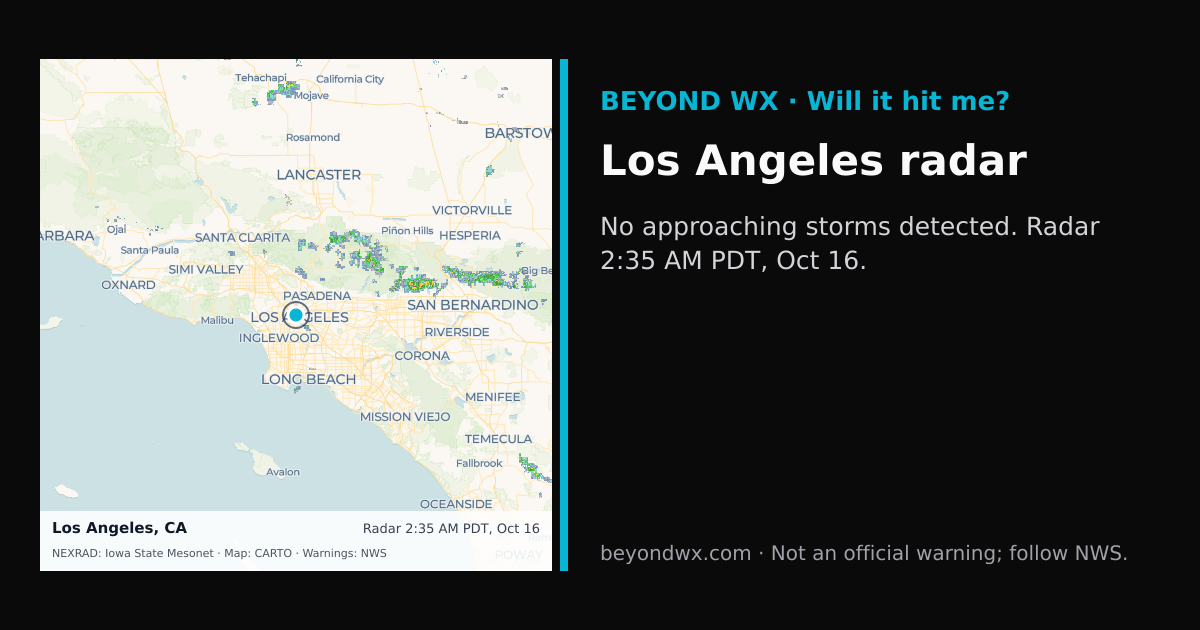
No rain expected in the next 2 hours.
No storms on track toward Los Angeles right now.
Hourly NWS forecast and radar storm motion. Times are local. Not an official warning; follow NWS.
Share: storm card image · live radar
Los Angeles, CA, is classified as having a Mediterranean climate (Köppen classification Csa), characterized by hot, dry summers and mild, wet winters. This climate type is typical of coastal southern California, where oceanic influences moderate temperatures throughout the year.
During the summer months, Los Angeles experiences average highs in the mid-80s°F, with lows typically in the mid-60s°F. In contrast, winter temperatures are mild, with average highs around 68°F and lows around 48°F. Spring and fall serve as transitional periods with moderate temperatures, gradually shifting between the extremes of summer and winter.
Los Angeles receives an average annual rainfall of approximately 15 inches, with the majority of precipitation occurring from November to March. February is typically the wettest month, while July and August are often the driest, receiving little to no measurable rainfall. Snow is extremely rare in Los Angeles itself due to its low elevation and coastal proximity.
Notable weather phenomena affecting the area include the Santa Ana winds, which occur primarily in the fall and winter months. These warm, dry winds increase wildfire risk, especially during prolonged dry periods. Los Angeles is also susceptible to extreme heat events, particularly during late summer when temperatures can occasionally exceed 100°F.
Geographically, Los Angeles is situated between the Pacific Ocean and the San Gabriel Mountains, which influences its weather patterns. The ocean provides a moderating effect, while the mountains can create a rain shadow effect, reducing precipitation in some areas. The city's varied topography contributes to microclimates, where temperature and precipitation can vary significantly over short distances.