58°F
Chance Rain Showers
Data: NOAA/National Weather Service. Forecast updated Oct 16, 2026, 7:47 AM UTC. Discussion issued Oct 16, 2026, 5:53 AM UTC.
Air Quality Index: 17 (Good)
SPC Convective Outlook: Slight Risk
Rain starts around 5:00 AM.
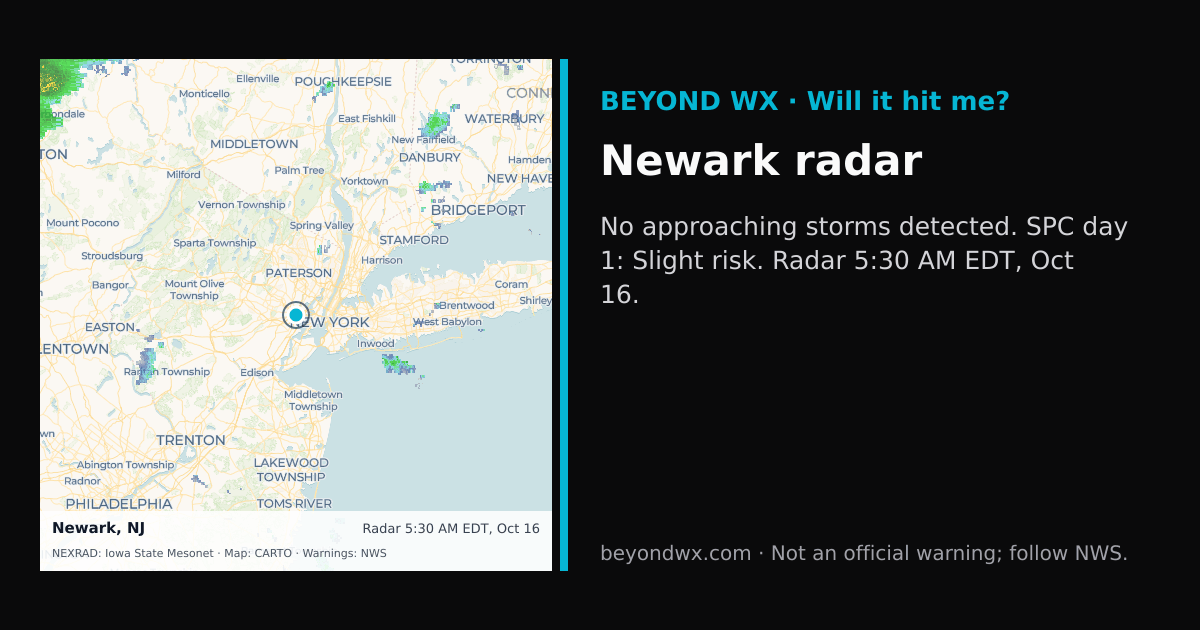
No storms on track toward Newark right now.
Hourly NWS forecast and radar storm motion. Times are local. Not an official warning; follow NWS.
Share: storm card image · live radar
Newark, NJ, located at 40.7357°N, 74.1724°W, has a humid subtropical climate with influences of a humid continental climate, characterized by hot, humid summers and cold winters. This classification reflects its position in the northeastern United States, where both continental and maritime influences affect the weather. Seasonal temperature variations are significant, with each season offering distinct weather patterns.
In Newark, summer temperatures average highs in the mid-80s°F, while lows hover in the upper 60s°F. Winters are typically cold, with average highs in the upper 30s°F and lows in the mid-20s°F. Spring and fall are transitional seasons, where temperatures gradually rise or fall, offering mild and pleasant conditions.
The city receives about 47 inches of precipitation annually, distributed fairly evenly throughout the year. However, July tends to be the wettest month, while February is often the driest. Newark also experiences snowfall, averaging around 26 inches per winter season, with January and February being the snowiest months.
Newark is susceptible to several notable weather phenomena, including the occasional impact from tropical storms or hurricanes, especially in late summer and early fall. While not in Tornado Alley, the area can experience infrequent tornadoes. Extreme heat events are also possible during summer months, occasionally pushing temperatures into the 90s°F or higher.
The geographic context of Newark, located near the Atlantic Ocean and relatively low in elevation, plays a crucial role in its climate. The proximity to large water bodies moderates temperature extremes and influences humidity levels, while the urban landscape contributes to the urban heat island effect, slightly elevating temperatures compared to surrounding rural areas.