67°F
Cloudy
Data: NOAA/National Weather Service. Forecast updated Oct 16, 2026, 7:57 AM UTC. Discussion issued Oct 16, 2026, 12:47 AM UTC.
Air Quality Index: 60 (Moderate)
No rain expected in the next 2 hours.
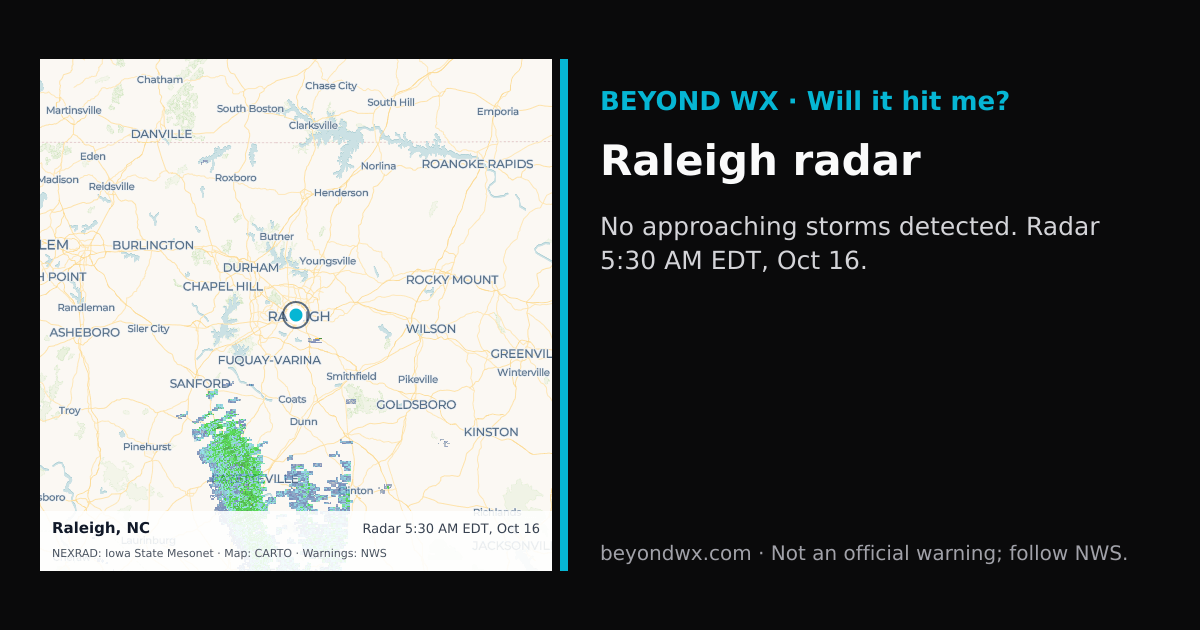
No storms on track toward Raleigh right now.
Hourly NWS forecast and radar storm motion. Times are local. Not an official warning; follow NWS.
Share: storm card image · live radar
Raleigh, NC, is classified as having a humid subtropical climate. This means it experiences hot, humid summers and generally mild to cool winters, typical of the southeastern United States. The region sees a significant variation in temperature and precipitation throughout the year due to its proximity to both the Atlantic Ocean and the Appalachian Mountains.
During the summer months, temperatures in Raleigh typically reach highs in the upper 80s to low 90s Fahrenheit, with overnight lows in the upper 60s to low 70s. Winters are relatively mild, with daytime highs averaging in the low to mid-50s and nighttime lows often dropping into the low 30s. Spring and fall are transitional seasons, with temperatures ranging from the 60s to 70s, providing a comfortable climate.
Raleigh receives an average annual rainfall of around 46 inches, with the wettest months being July and August due to frequent thunderstorms. The driest months are typically October and November. Snowfall is infrequent, averaging about 5 inches per year, mainly occurring in January and February.
The area is susceptible to weather phenomena such as hurricanes, which can bring heavy rains and strong winds during the late summer and early fall. Although not in the heart of Tornado Alley, Raleigh occasionally experiences tornadoes, particularly during the spring. Ice storms can also occur during the winter months, leading to hazardous conditions.
Situated in the Piedmont region of North Carolina, Raleigh's elevation is approximately 315 feet above sea level. This geographic setting, combined with its distance from the coast, moderates temperatures slightly compared to coastal areas, while still allowing for significant moisture and precipitation patterns influenced by the Atlantic Ocean.