49°F
Clear
Data: NOAA/National Weather Service. Forecast updated Oct 16, 2026, 6:30 AM UTC. Discussion issued Oct 15, 2026, 7:07 PM UTC.
Air Quality Index: 42 (Good)
No rain expected in the next 2 hours.
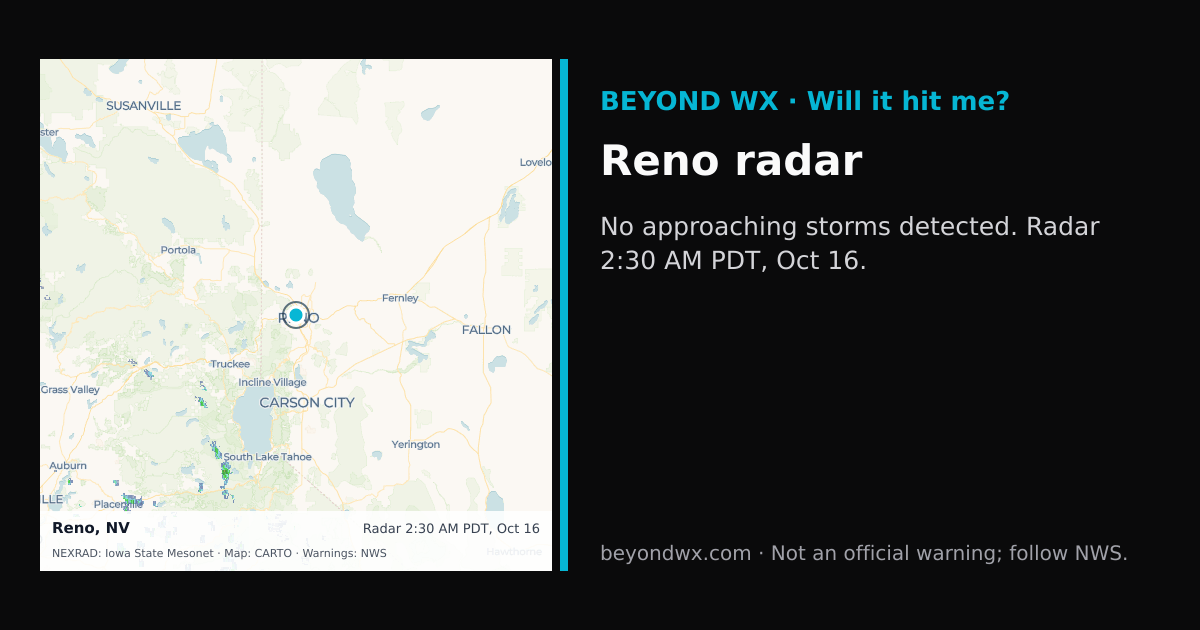
No storms on track toward Reno right now.
Hourly NWS forecast and radar storm motion. Times are local. Not an official warning; follow NWS.
Share: storm card image · live radar
Reno, NV, located at 39.5296°N and 119.8138°W, experiences a semi-arid climate, characterized by hot, dry summers and cold, moist winters. This climate classification leads to a wide range of temperatures and significant seasonal variation. The city lies within the rain shadow of the Sierra Nevada, contributing to its low overall precipitation levels.
During summer, Reno typically sees high temperatures averaging in the mid-90s°F, with lows around the mid-50s°F. Winter temperatures can drop significantly, with highs generally in the mid-40s°F and lows often near 25°F. Spring and fall provide milder conditions, with temperatures ranging from the 50s to 70s°F, making these transitional seasons more temperate.
Reno receives an average annual precipitation of about 7 inches, with most rainfall occurring between November and March. December is usually the wettest month, while July tends to be the driest. Snowfall is common in winter, averaging around 22 inches annually, although this can vary significantly year to year.
The region is prone to notable weather phenomena such as wildfires during the hot, dry summer months. The high elevation and proximity to the Sierra Nevada can lead to rapid changes in weather conditions, including sudden snowstorms in winter. Additionally, Reno is not significantly impacted by tornadoes or hurricanes, but extreme heat and dry conditions can pose challenges, particularly during the peak of summer.
Reno's geographic setting at approximately 4,500 feet above sea level, coupled with its location near the Sierra Nevada, significantly influences its weather patterns. The mountains act as a barrier to Pacific storms, creating dry conditions, while the elevation contributes to cooler temperatures and a greater likelihood of snowfall compared to lower surrounding areas.