62°F
Clear
Data: NOAA/National Weather Service. Forecast updated Oct 16, 2026, 8:26 AM UTC. Discussion issued Oct 16, 2026, 4:52 AM UTC.
Air Quality Index: 57 (Moderate)
No rain expected in the next 2 hours.
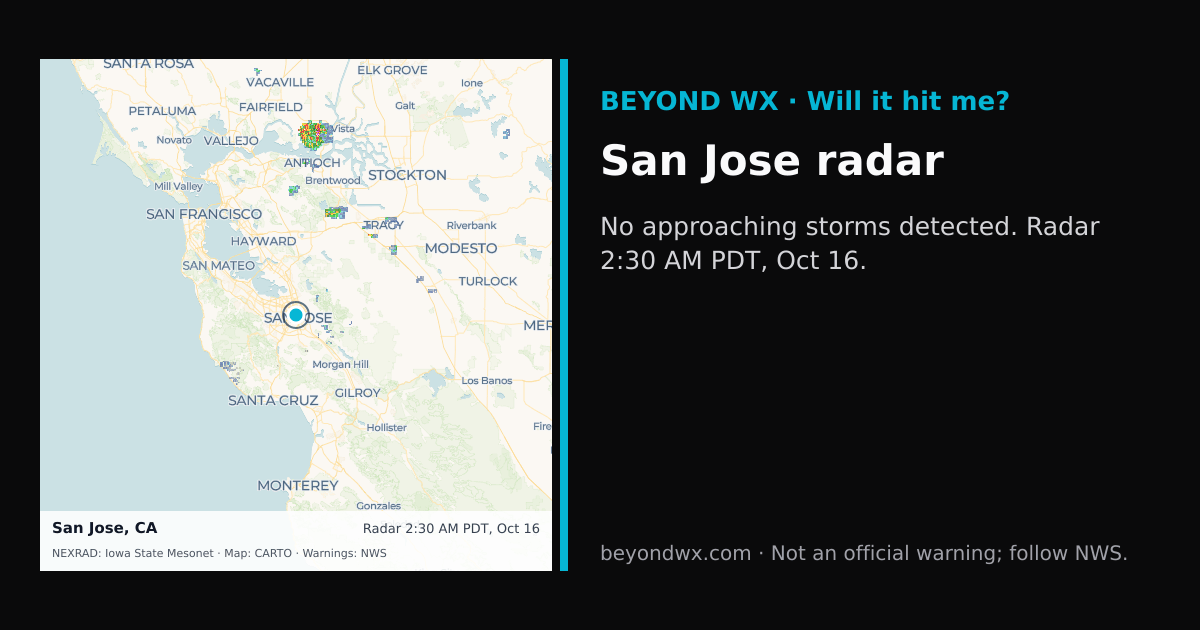
No storms on track toward San Jose right now.
Hourly NWS forecast and radar storm motion. Times are local. Not an official warning; follow NWS.
Share: storm card image · live radar
San Jose, CA, is classified under the Mediterranean climate category, characterized by mild, wet winters and hot, dry summers. This climate type, denoted as "Csa" in the Köppen climate classification, is typical for regions along the western coasts of continents near large bodies of water, where oceanic influences moderate temperature extremes.
In San Jose, summer temperatures typically range from highs in the mid-80s°F to lows in the high 50s°F. Winters are cooler with average highs in the upper 50s°F and lows in the low 40s°F. Spring and fall serve as transitional periods with moderate temperatures; spring sees warming trends while fall experiences gradual cooling.
Annual precipitation in San Jose averages around 15 inches, with the majority falling between November and March. January is usually the wettest month, while the summer months from June to September are notably dry, often with no measurable rain. Snow is exceedingly rare in the city proper due to its low elevation and milder coastal influence.
San Jose does not experience extreme weather phenomena such as tornadoes or hurricanes. However, the region is susceptible to drought conditions and occasional wildfires in surrounding areas, especially during hot, dry summers. The city can also experience periods of poor air quality due to wildfire smoke.
San Jose is situated in the Santa Clara Valley, bordered by the Santa Cruz Mountains to the southwest and the Diablo Range to the northeast. Its elevation of around 82 feet above sea level, coupled with its proximity to the Pacific Ocean, helps moderate the climate, keeping temperatures mild and reducing the likelihood of extreme weather events.