41°F
Partly Cloudy
Data: NOAA/National Weather Service. Forecast updated Oct 16, 2026, 6:32 AM UTC. Discussion issued Oct 16, 2026, 5:21 AM UTC.
Air Quality Index: 52 (Moderate)
No rain expected in the next 2 hours.
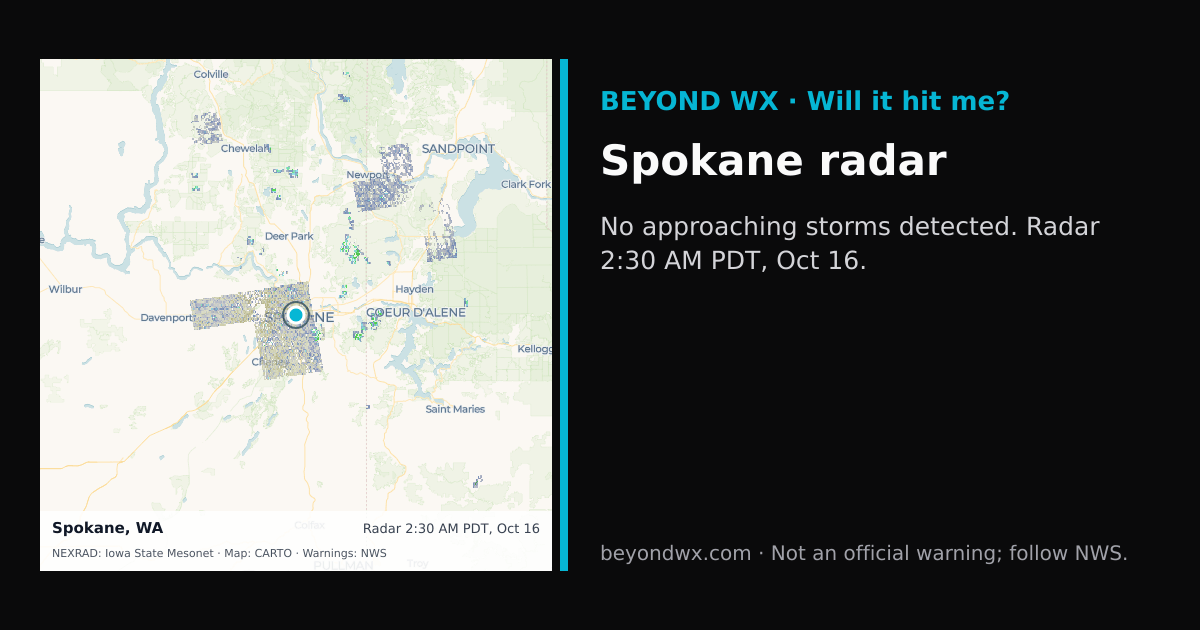
No storms on track toward Spokane right now.
Hourly NWS forecast and radar storm motion. Times are local. Not an official warning; follow NWS.
Share: storm card image · live radar
Spokane, WA, located at 47.6588°N, 117.4260°W, experiences a humid continental climate characterized by distinct seasons with considerable temperature variation. Summers are generally warm and dry, while winters are cold and snowy. This climate type results in diverse weather patterns throughout the year, influenced by the region's inland location and elevation.
During the summer months, Spokane typically sees high temperatures ranging from the mid-80s to low 90s °F, with lows in the mid-50s to low 60s °F. Winters, on the other hand, bring highs in the low to mid-30s °F and lows often dipping into the low 20s °F. Spring and fall serve as transition periods with milder conditions, where temperatures gradually shift between the extremes of summer and winter.
Spokane receives an average annual precipitation of about 17 inches, with December being the wettest month and July the driest. Snowfall is a significant component of the winter climate, averaging around 45 inches annually, contributing to the cold-season precipitation total. The snowfall is influenced by the region's geography and elevation, which can lead to significant snowpack accumulation in some years.
Wildfires represent a notable weather phenomenon in the Spokane area, particularly during late summer and early fall when dry conditions prevail and temperatures remain high. The surrounding landscape, characterized by forested areas and rolling hills, can be susceptible to wildfires, which may impact air quality and visibility. Spokane’s elevation of approximately 1,843 feet above sea level and its location east of the Cascade Range also influence local weather patterns, contributing to its unique climate characteristics.