57°F
Cloudy
Data: NOAA/National Weather Service. Forecast updated Oct 16, 2026, 7:06 AM UTC. Discussion issued Oct 16, 2026, 3:48 AM UTC.
Air Quality Index: 18 (Good)
No rain expected in the next 2 hours.
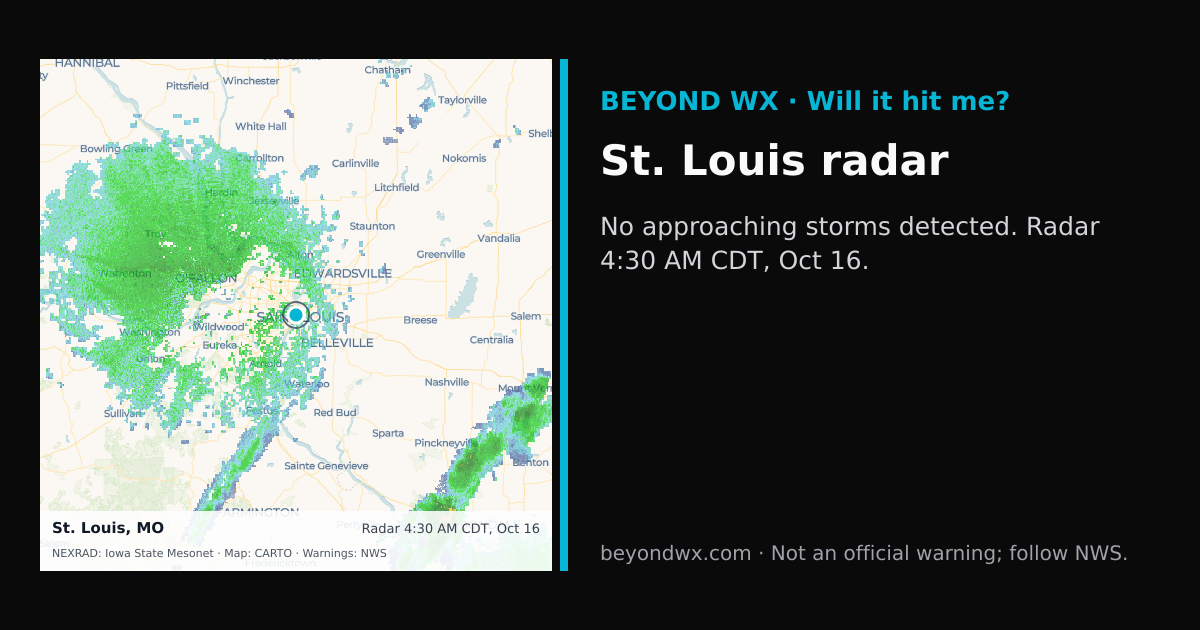
No storms on track toward St. Louis right now.
Hourly NWS forecast and radar storm motion. Times are local. Not an official warning; follow NWS.
Share: storm card image · live radar
St. Louis, Missouri, is classified as having a humid continental climate, characterized by hot, humid summers and cold winters. This classification reflects the city's location in the interior of the United States, where it experiences significant seasonal temperature variations. Summers are typically hot with average high temperatures in July reaching around 89°F and lows around 70°F. In contrast, winters are cold, with January highs averaging around 39°F and lows dipping to about 23°F. Spring and fall provide a transitional period with more moderate temperatures.
Precipitation in St. Louis is well-distributed throughout the year, totaling approximately 41 inches annually. May tends to be the wettest month, often receiving over 4.5 inches of rain, while January is usually the driest month, with just over 2 inches. Snowfall is a feature of the winter months, with an average annual accumulation of about 18 inches, primarily between December and February.
St. Louis is located on the edge of Tornado Alley, making it susceptible to severe thunderstorms and tornadoes, particularly during the spring and early summer. The city occasionally experiences extreme heat in the summer and ice storms in the winter, which can disrupt daily life and transport. Its location near the confluence of the Mississippi and Missouri Rivers also influences local weather patterns, contributing to humidity and precipitation.
The geographic setting of St. Louis, at an elevation of approximately 466 feet above sea level, influences its climate by allowing for the free movement of air masses from both the Arctic and the Gulf of Mexico. This contributes to the city's variable weather and the potential for rapid weather changes. The absence of significant topographical barriers permits these air masses to interact, often resulting in dynamic weather conditions.