51°F
Partly Cloudy
Data: NOAA/National Weather Service. Forecast updated Oct 16, 2026, 11:50 PM UTC. Discussion issued Oct 16, 2026, 11:12 PM UTC.
Air Quality Index: 24 (Good)
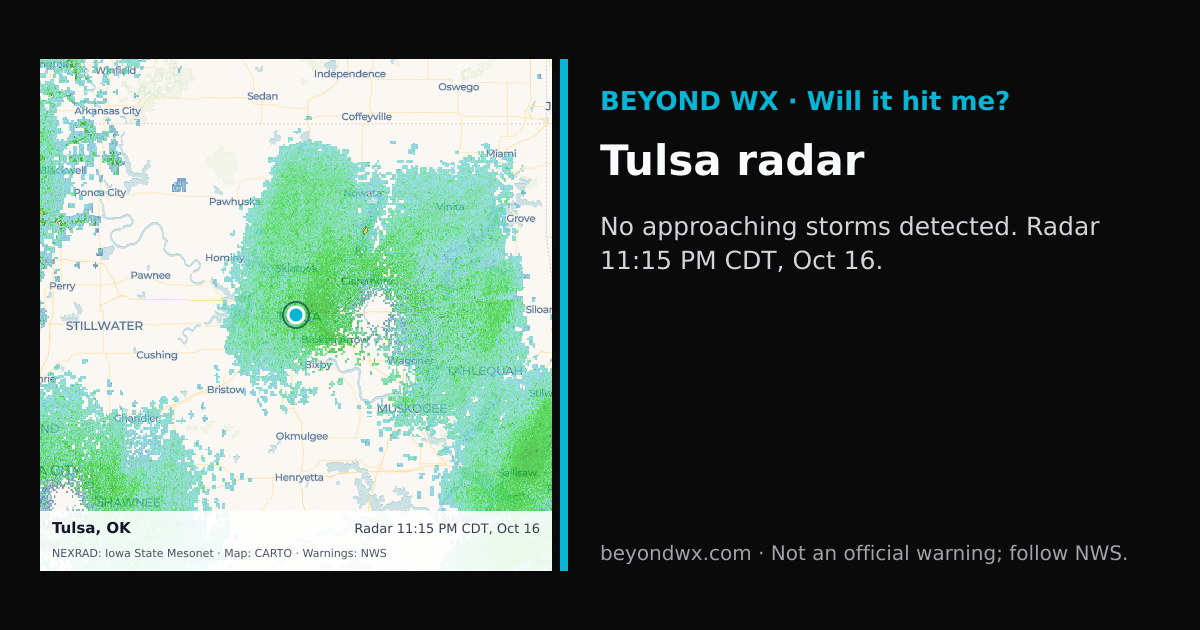
No rain expected in the next 2 hours.
No storms on track toward Tulsa right now.
Hourly NWS forecast and radar storm motion. Times are local. Not an official warning; follow NWS.
Share: storm card image · live radar
Tulsa, Oklahoma, is characterized by a humid subtropical climate, with distinct seasonal variations typical of the south-central United States. The city experiences hot summers and mild to cool winters, influenced by its location in the Great Plains region. Tulsa's summers are typically hot, with average high temperatures in July reaching around 93°F, while lows hover near 73°F. Winters are cooler, with January highs averaging 47°F and lows around 27°F. Spring and fall are transitional seasons, with spring bringing moderate temperatures and increasing rainfall, while fall offers mild conditions and a gradual cooling.
Precipitation in Tulsa averages about 41 inches annually, with May being the wettest month, often exceeding 5 inches of rain. The driest months are typically January and February when precipitation levels drop to around 1.5 inches. Snowfall is relatively light but not uncommon, with annual totals averaging about 6 inches, primarily occurring from November through March.
Tulsa lies within Tornado Alley, making it susceptible to severe weather, particularly in spring when tornadoes and strong thunderstorms are more frequent. The region also encounters occasional ice storms during winter months, which can disrupt infrastructure. The city does not face direct hurricane impacts but can experience remnants of tropical systems bringing heavy rains.
Situated at an elevation of approximately 722 feet, Tulsa's weather is influenced by its location on the Arkansas River and proximity to the Ozark Mountains to the east. These geographic features contribute to the area's climate patterns, impacting both temperature variations and precipitation distribution.