59°F
Cloudy
Data: NOAA/National Weather Service. Forecast updated Oct 16, 2026, 6:35 AM UTC. Discussion issued Oct 16, 2026, 2:59 AM UTC.
Air Quality Index: 54 (Moderate)
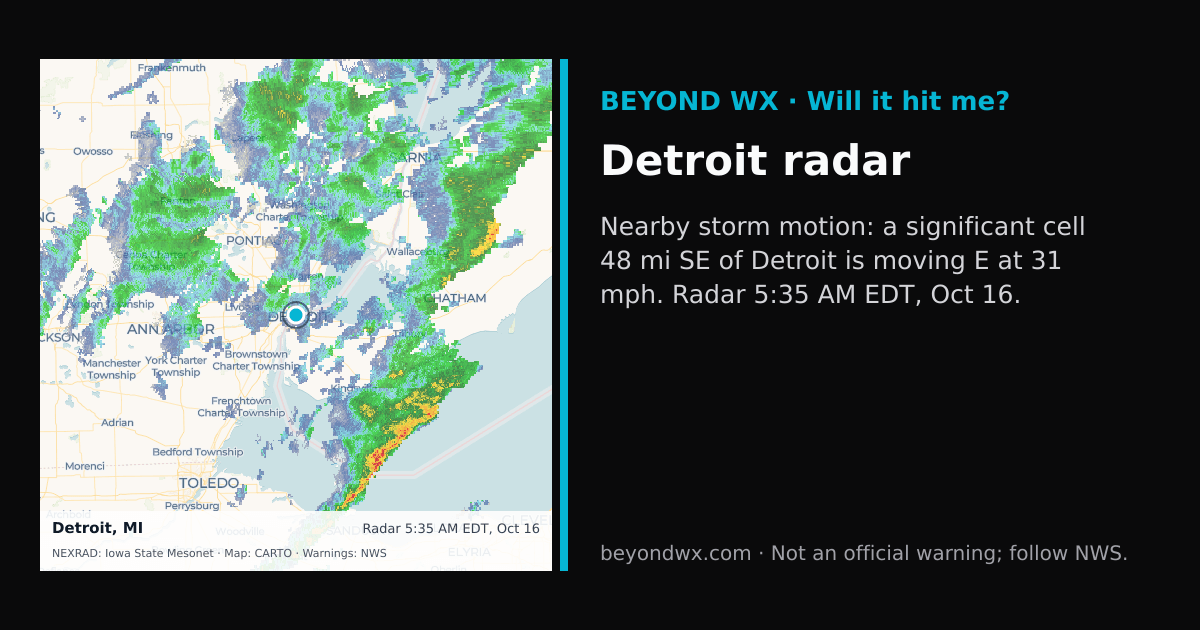
No rain expected in the next 2 hours.
Hourly NWS forecast and radar storm motion. Times are local. Not an official warning; follow NWS.
Share: storm card image · live radar
Detroit, MI, is classified under the humid continental climate zone, characterized by distinct seasonal temperature variations. Winters are cold, while summers are warm to hot. This climate classification is common in the Midwestern United States, influenced by both the Great Lakes and continental air masses.
In the summer months, temperatures in Detroit typically range from highs in the low 80s to lows in the mid-60s Fahrenheit. During winter, temperatures can drop significantly, with highs often in the mid-30s and lows in the low 20s. Spring and fall serve as transitional periods, with spring temperatures gradually warming and fall seeing a cooling trend, making both seasons relatively mild compared to the extremes of summer and winter.
Precipitation in Detroit is well-distributed throughout the year, totaling around 33 inches annually. The wettest months are typically May and June, while February is often the driest. Snowfall is a significant aspect of Detroit's winter climate, with an average of about 43 inches of snow annually, influenced by cold air masses and proximity to the Great Lakes.
Detroit does not experience significant impacts from tornadoes or hurricanes but is susceptible to lake effect snow due to its location near the Great Lakes. Ice storms are also a notable weather phenomenon, especially during late fall and winter, posing challenges for transportation and infrastructure.
Geographically, Detroit is situated at a relatively low elevation, approximately 600 feet above sea level, which contributes to its weather patterns. The city's location near Lake Erie and Lake St. Clair moderates temperature extremes to some extent but also contributes to higher humidity and precipitation levels, particularly in the form of lake effect snow and rain.