35°F
Chance Rain And Snow
Data: NOAA/National Weather Service. Forecast updated Oct 16, 2026, 8:22 AM UTC. Discussion issued Oct 15, 2026, 10:06 PM UTC.
Air Quality Index: 23 (Good)
Rain likely now and through the next 2 hours.
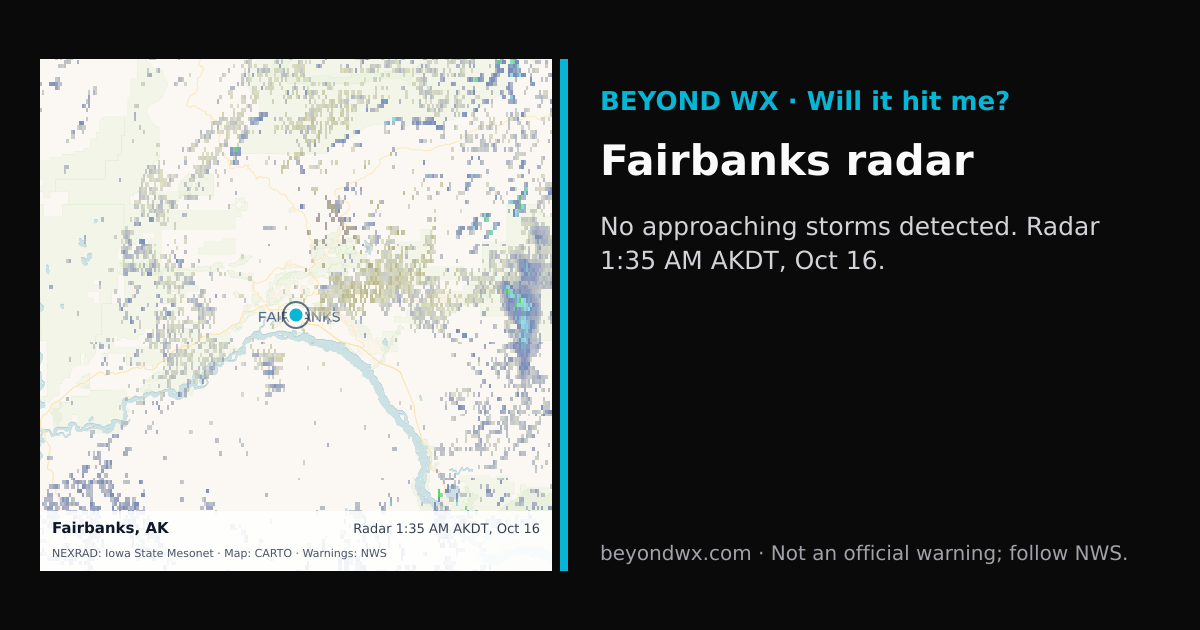
No storms on track toward Fairbanks right now.
Hourly NWS forecast and radar storm motion. Times are local. Not an official warning; follow NWS.
Share: storm card image · live radar
Fairbanks, Alaska, is characterized by a subarctic climate, marked by long, cold winters and short, warm summers. This climate classification is typical of areas situated at high latitudes with significant seasonal temperature variations. Located in the interior region of Alaska, Fairbanks experiences a continental climate with cold air masses dominating during winter and warm air masses influencing summer conditions.
During the summer months, temperatures in Fairbanks range from average highs in the mid-70s°F to lows in the mid-50s°F. Conversely, winter temperatures plummet drastically, with average highs around 0°F and lows often dropping to -20°F or lower. Spring and fall are transitional periods with rapidly changing temperatures, with spring seeing a swift warming in April and May, and fall witnessing a quick descent into colder temperatures by October.
Annual precipitation in Fairbanks is relatively low, averaging around 11 inches, with the majority occurring during the summer months. July is typically the wettest month, while winter months see minimal precipitation, albeit in the form of snow. Fairbanks receives about 65 inches of snow annually, contributing to its lengthy snow cover period.
Fairbanks is not prone to severe weather phenomena such as tornadoes or hurricanes, but it does experience extended periods of extreme cold and occasional ice fog, particularly in the winter. The city is also susceptible to wildfire activity in the surrounding forests during the dry summer months.
Situated at an elevation of approximately 440 feet above sea level, Fairbanks is nestled in the Tanana Valley. This geographic setting, along with its latitude, influences the local climate by creating a temperature inversion during winter, which contributes to the persistence of cold air and ice fog in the region.