75°F
Partly Cloudy
Data: NOAA/National Weather Service. Forecast updated Oct 16, 2026, 6:21 AM UTC. Discussion issued Oct 16, 2026, 5:40 AM UTC.
Air Quality Index: 44 (Good)
SPC Convective Outlook: Thunderstorm Risk
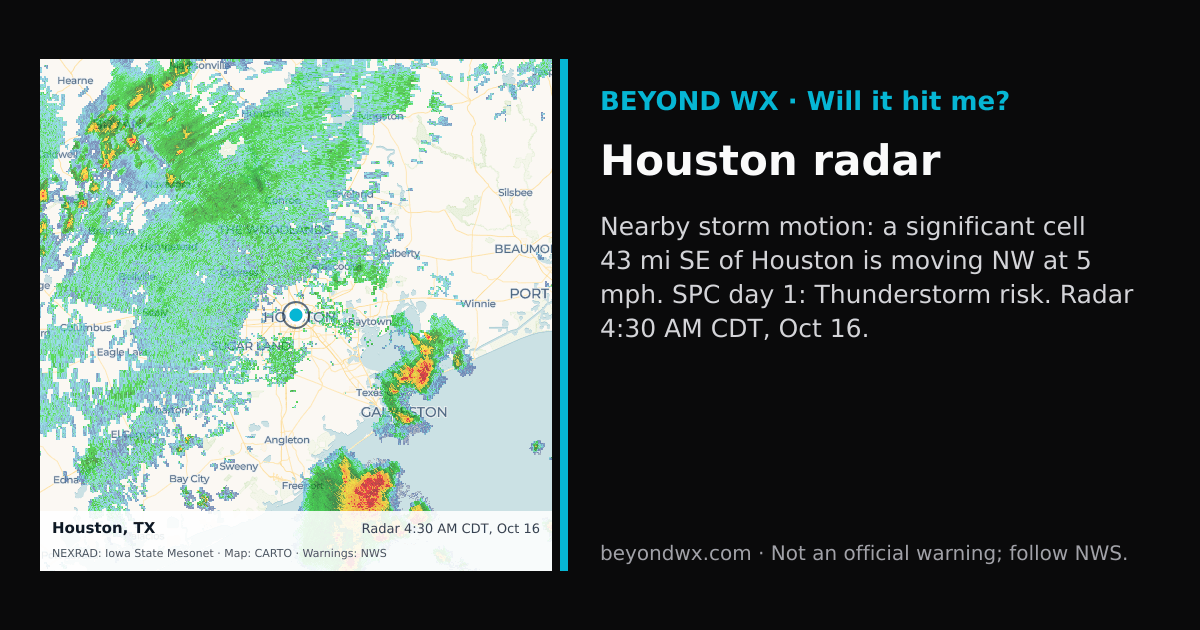
No rain expected in the next 2 hours.
Hourly NWS forecast and radar storm motion. Times are local. Not an official warning; follow NWS.
Share: storm card image · live radar
Houston, TX features a humid subtropical climate, characterized by hot, humid summers and mild to cool winters. The city's proximity to the Gulf of Mexico significantly influences its weather patterns, contributing to high humidity and frequent rainfall. The area experiences a long summer season, with temperatures typically ranging from highs in the mid-90s°F to lows in the mid-70s°F. Winters are relatively mild, with average highs in the 60s°F and lows in the 40s°F. Spring and fall offer transitional temperatures, often fluctuating between warm and cool conditions.
Houston receives an average annual rainfall of about 50 inches, making it one of the wetter major cities in the United States. The wettest months are typically May and October, while February often sees the least precipitation. Snow is rare in Houston, occurring infrequently and usually melting quickly. The city's precipitation is mainly due to its coastal location, which allows moist air masses to move inland.
Notable weather phenomena affecting Houston include the risk of hurricanes and tropical storms, particularly from June to November. The city's low elevation and flat terrain make it susceptible to flooding during heavy rain events. Houston is also occasionally affected by severe thunderstorms that may produce strong winds and tornadoes, though it is not located in the heart of Tornado Alley.
Geographically, Houston sits at a low elevation of about 50 feet above sea level, with a flat terrain that influences its weather patterns. The nearby Gulf of Mexico plays a crucial role in moderating temperatures and contributing to high humidity levels, while the city's sprawling urban environment can intensify heat and alter local wind patterns.