41°F
Clear
Data: NOAA/National Weather Service. Forecast updated Oct 17, 2026, 3:06 AM UTC. Discussion issued Oct 16, 2026, 7:37 PM UTC.
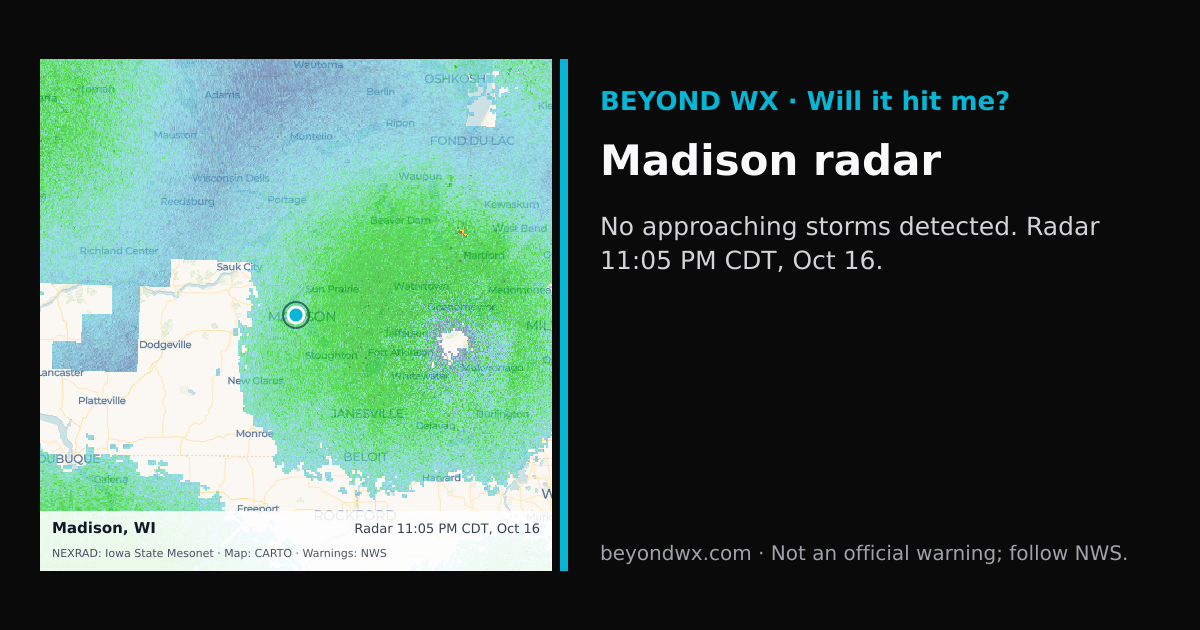
No rain expected in the next 2 hours.
No storms on track toward Madison right now.
Hourly NWS forecast and radar storm motion. Times are local. Not an official warning; follow NWS.
Share: storm card image · live radar
Madison, WI, is characterized by a humid continental climate, marked by significant seasonal temperature variations. This classification is typical for the Midwest, where summers are warm and humid, while winters are cold and snowy. The climate in this region reflects the inland position, away from the moderating effects of oceans.
Summers in Madison typically see high temperatures ranging from the mid-70s to the mid-80s Fahrenheit, with lows in the mid-50s to low 60s. Winters are cold, with high temperatures often in the low to mid-30s and lows dipping into the teens or lower. Spring and fall serve as transitional seasons with moderate temperatures, though spring can be quite wet, and fall is generally drier.
Madison receives an average of about 36 inches of precipitation annually, with the wettest months being May through August. Snowfall is a significant component of winter, with the area receiving approximately 50 inches of snow annually. January is typically the snowiest month, contributing to the cold and icy conditions.
The city is not part of the traditional Tornado Alley, but it is still susceptible to severe thunderstorms and occasional tornadoes. Winter storms can be quite impactful, delivering heavy snow and ice. Madison's location in the Great Lakes region mitigates certain extremes but also contributes to variable weather patterns.
Situated at an elevation of around 860 feet, Madison's weather is influenced by its proximity to several lakes, including Lake Mendota and Lake Monona, which can moderate temperatures slightly but also contribute to localized weather phenomena such as lake-effect snow or fog. The broader topography of the Midwest, with its flat plains, allows cold air masses to move freely, influencing the region's winter severity.